The Regulated Product Lifecycle
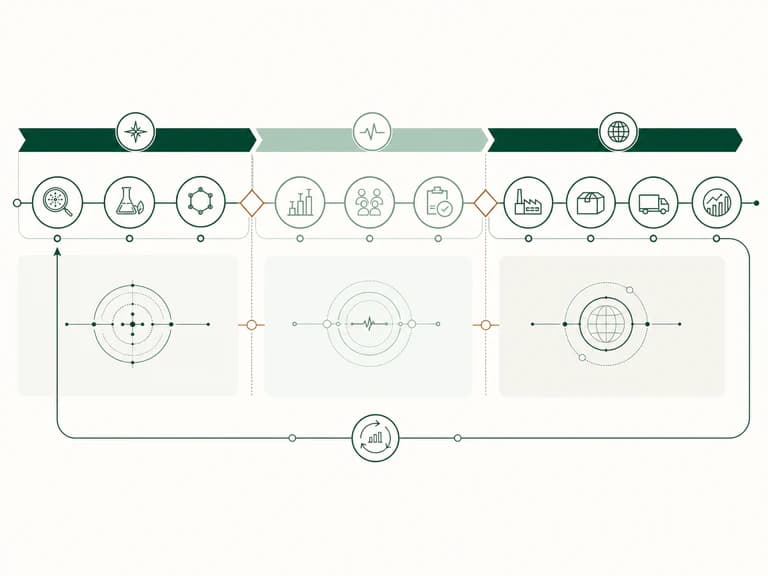
The 15 phases a regulated product moves through, research and discovery to discontinuation. Each phase carries what happens, what must be true to enter and leave it, what the quality function owns there, the records it produces, and where it goes wrong.
Phases are an organising device, not a regulatory mandate — real programmes overlap them, and a medical device, a food product and a small-molecule drug traverse them differently. Each page says where the differences bite.
How to use this library
Read it in order once, then use the controls to light the phases where your practice is exercised or your system is shaped. Each row carries how many standards bite there and how many systems carry the work.
Phases are an organising device, not a regulatory mandate — real programmes overlap them, and a medical device, a food product and a small-molecule drug traverse them differently. Each page says where the differences bite.
- Research & DiscoveryPHASE 01Where the product idea is found and shaped — target identification, candidate selection, and concept work, before most GxP obligations formally attach.5standards bite here3systems carry itQMSGDocP6 records produced
- Nonclinical DevelopmentPHASE 02The GLP-governed safety programme — toxicology, safety pharmacology, and biocompatibility — that justifies exposing humans or target animals to the product.6standards bite here3systems carry itGLPGDocPQMSCSV6 records produced
- Clinical DevelopmentPHASE 03The GCP-governed trial programme — from first-in-human through pivotal studies — that generates the evidence of safety and efficacy in people.8standards bite here5systems carry itGCPGVPGCLPCSV+16 records produced
- Regulatory Submission & ApprovalPHASE 04Where the evidence becomes a dossier — compiled, reviewed, defended, and approved — and the registered details become binding commitments.8standards bite here3systems carry itQMSGDocPCSVGMP6 records produced
- Technology TransferPHASE 05The controlled movement of product and process knowledge between sites — from development to commercial, or site to site — proven by comparable results.7standards bite here4systems carry itGMPQMSGDocPGEP6 records produced
- Process Development & CharacterisationPHASE 06Where the commercial process is designed and understood — CQAs, CPPs, and the control strategy that will govern manufacturing for the product's life.7standards bite here4systems carry itGMPQMSGEPGDocP6 records produced
- Commissioning & QualificationPHASE 07Where facilities, utilities, and equipment are engineered, installed, and proven fit for intended use — the GEP-to-GMP handover.8standards bite here3systems carry itGEPGMPCSVQMS6 records produced
- ValidationPHASE 08The documented demonstration that processes, methods, cleaning, sterilisation, and computerised systems consistently deliver their intended results.8standards bite here4systems carry itGMPCSVGEPQMS+16 records produced
- Commercial ManufacturingPHASE 09Routine production under GMP — batch execution, disposition, deviation handling, and the continued verification that keeps the validated state honest.8standards bite here5systems carry itGMPQMSGDocPGEP6 records produced
- Laboratory ControlPHASE 10The QC laboratory's standing verdict on product and environment — testing, stability, OOS discipline, and the data integrity every release rests on.8standards bite here3systems carry itGMPGDocPCSVQMS6 records produced
- Packaging & SerialisationPHASE 11Where product becomes a labelled, traceable, market-ready unit — packaging control, container integrity, and the unique identifier on every saleable pack.5standards bite here3systems carry itGMPGDPQMSCSV6 records produced
- Storage & DistributionPHASE 12The GDP phase — warehousing, transport, and supply-chain integrity that keep a released product within its conditions until it reaches the patient or customer.6standards bite here3systems carry itGDPGMPQMSGDocP6 records produced
- PharmacovigilancePHASE 13The GVP-governed safety system for marketed medicines — case processing on regulatory clocks, signal detection, and the benefit-risk file kept current for life.7standards bite here3systems carry itGVPGDocPCSVQMS6 records produced
- Post-Market SurveillancePHASE 14The feedback engine after launch — complaints, vigilance, trending, and field actions — where real-world performance is watched and acted on.6standards bite here3systems carry itQMSGVPGDocPCSV6 records produced
- Discontinuation & Record RetentionPHASE 15The controlled end of life — withdrawal, wind-down, and the archive that keeps decades of obligations answerable long after the product is gone.6standards bite here4systems carry itGDocPQMSCSVGMP6 records produced
COMPLETE INDEX — ALL 15 PHASE
- 1. Research & Discovery
- 2. Nonclinical Development
- 3. Clinical Development
- 4. Regulatory Submission & Approval
- 5. Technology Transfer
- 6. Process Development & Characterisation
- 7. Commissioning & Qualification
- 8. Validation
- 9. Commercial Manufacturing
- 10. Laboratory Control
- 11. Packaging & Serialisation
- 12. Storage & Distribution
- 13. Pharmacovigilance
- 14. Post-Market Surveillance
- 15. Discontinuation & Record Retention
Every count on a phase row is derived at render from the coverage crosswalk — the standards and systems each phase actually references.
What SPEQ decodes at each phase.
Every phase, crossed against the standards, disciplines, systems, and topics SPEQ covers there — 15 of 15 phases fully covered, spanning 73 standards, 18 systems, and 47 topics.
Data-derived from the lifecycle catalog — never hand-maintained.