[ REGULATED PROJECT DELIVERY · EXECUTION METHODOLOGY ]
From concept to commercial release — with quality built in at every gate.
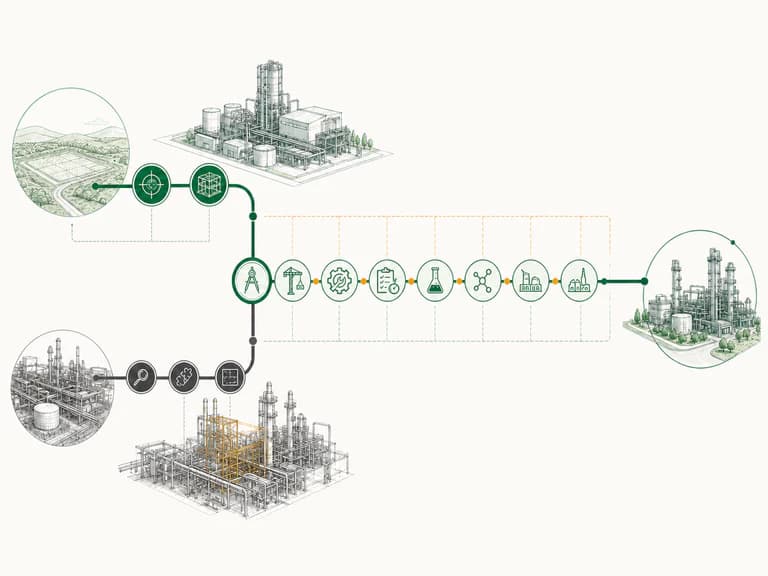
How regulated projects actually get delivered — the lifecycle from concept through design, construction, commissioning & qualification, and validation to commercial release, with quality built in at every gate rather than inspected in at the end.
[ WHY THIS PAGE EXISTS ]
Project-management bodies teach delivery without regulatory context; regulators publish requirements without delivery methodology. SPEQ bridges the two — this page is the operating view of the framework’s Execution Methodology layer.
[ THE DELIVERY LIFECYCLE ]
7 phases. One thread of quality.
The regulated-project arc from first concept to commercial supply — what happens in each phase, what quality owns there, and the deliverables that become the inspection record. A SPEQ synthesis of the delivery methods and GxP guidance on the shelf below.
Concept & feasibility
The business case, product and capacity requirements, and the regulatory strategy are framed. Decisions made here — technology selection, site, contracting model — set the compliance burden for everything downstream.
WHAT QUALITY OWNS HERE
A seat at the table from day one: regulatory-strategy input, early user requirements, and the quality criteria the project will be judged against.
KEY DELIVERABLES
- Business case & project charter
- Initial user requirements (URS) outline
- Regulatory strategy memo
- Quality project plan (first issue)
Design & engineering
Requirements become specifications. Under ASTM E2500 thinking, design review and design qualification happen here — quality risk management decides which design elements are critical to product quality and patient safety.
WHAT QUALITY OWNS HERE
Quality-by-design input: URS approval, critical aspects & critical design elements identification, and risk assessments that will drive verification scope.
KEY DELIVERABLES
- User requirements specification (URS)
- Functional & design specifications
- System-level impact / criticality assessments
- Design review & design qualification records
Construction & build
Facilities, utilities, equipment, and systems are built or configured. Good Engineering Practice governs the work; vendor documentation, FATs, and installation records become the evidence base later verification will leverage.
WHAT QUALITY OWNS HERE
Oversight of GEP execution: vendor and supplier quality, FAT/SAT witness points, and the document trail that lets C&Q leverage vendor testing instead of repeating it.
KEY DELIVERABLES
- Construction turnover packages
- Factory / site acceptance test (FAT/SAT) records
- Installation records & red-lines
- Vendor documentation packages
Commissioning & qualification
Systems are verified fit for intended use. Risk-based C&Q per ASTM E2500 and ISPE Baseline Guide Vol. 5 scales the verification effort to product-quality impact — direct-impact systems get qualification rigor, the rest get good commissioning.
WHAT QUALITY OWNS HERE
The acceptance and release decision: approving C&Q strategy, reviewing verification against pre-defined acceptance criteria, and releasing systems for GMP use.
KEY DELIVERABLES
- C&Q plan / verification strategy
- Commissioning & qualification protocols and reports (IQ/OQ or verification equivalents)
- Discrepancy & punch-list resolution
- System release / handover certificates
Process validation & PPQ
The process itself is proven. Stage 1 process design carries into Stage 2 process performance qualification on the new asset, with computerised systems validated under GAMP 5 alongside.
WHAT QUALITY OWNS HERE
Protocol approval, batch disposition during PPQ, and the judgement that the process is in a state of control before commercial supply.
KEY DELIVERABLES
- Process validation master plan
- PPQ protocols & reports
- Computerised system validation packages (GAMP 5)
- Cleaning validation & environmental monitoring baselines
Regulatory & inspection readiness
The evidence is assembled for the market: submission sections drawn from project deliverables, and the site prepared for pre-approval or pre-license inspection where one applies.
WHAT QUALITY OWNS HERE
Inspection readiness end-to-end: the story of the project told through its documentation, mock inspections, and the data-integrity of every record the inspector will pull.
KEY DELIVERABLES
- Submission-supporting documentation
- Inspection-readiness assessments & mock audits
- Quality system integration (deviations, CAPA, change control live on the new asset)
Commercial release & handover
The project dissolves into operations. Ongoing monitoring, periodic review, and continued process verification take over — and the lessons learned feed the next project’s concept phase.
WHAT QUALITY OWNS HERE
The handover gate: confirming operational readiness, closing project quality actions, and standing up continued process verification and periodic review.
KEY DELIVERABLES
- Project closure & lessons-learned report
- Continued process verification (Stage 3) plan
- Operational SOPs & training completion
- Asset lifecycle & maintenance plans
The lifecycle framing and phase narratives are a SPEQ synthesis — a practitioner on-ramp, not any single body’s method.
[ THE DELIVERABLES MATRIX ]
18 deliverables. Who owns each, and why it’s a record.
The regulated deliverables across all 7 phases, with a RACI-style ownership call and the regulatory reason each one is an inspectable record — not disposable project paperwork. Ownership is a SPEQ synthesis.
[ THE FULL 16-PHASE MODEL ]
The familiar seven, expanded to 16.
The seven-phase view above is the on-ramp. A real regulated capital project runs a finer, gated 16-phase lifecycle — discovery to close-out — each phase with its own gate to advance. Below, the seven map onto the sixteen, then every phase in full.
SPEQ synthesis · slice 1 authors each phase’s purpose, gate criteria, and business effect; the rest of the 14-question grammar is authored in coming releases.
HOW THE SEVEN EXPAND
Front-end planning
open cluster →The business case and basis of design — where the compliance burden is set.
00Business case & conceptThe investment thesis, product and capacity requirements, and the first regulatory strategy. Decisions here — modality, make-vs-buy, target markets — set the compliance burden for everything downstream.grammar ▾
- Purpose
Decide whether and why to build, and frame the regulatory and quality strategy before any money is committed to design.
- Work performed
- Build the business case, capacity model, and target-market analysis
- Frame the regulatory strategy and applicable frameworks per market
- Set the make-vs-buy and technology/modality direction
- Define the high-level quality criteria the project will be judged against
- Who is involved
- Executive sponsor and corporate development
- Regulatory affairs and the quality unit
- Technical operations and engineering leadership
- What quality owns
- Regulatory-strategy input and the first quality criteria
- A veto on modality/market choices that cannot be qualified or inspected
- What engineering owns
- Feasibility of the technology and capacity concept
- Rough order-of-magnitude cost and schedule for the technical scope
- What operations owns
- The demand, capacity, and reliability assumptions the case rests on
- Input on operability of the proposed modality
- Management decisions
- Go/no-go on funding the next phase
- Target markets, modality, and make-vs-buy
- Deliverables
- Business case & project charter
- Regulatory strategy memo
- Quality project plan (first issue)
- Evidence to retain
- The approved business case and charter
- The regulatory strategy of record
- Common risks
- A modality or market chosen without regulatory input
- Optimistic capacity/demand assumptions never revisited
- Gate criteria to advance
- An approved business case with a defined product, capacity, and target markets
- A first regulatory strategy naming the applicable frameworks and markets
- Quality represented in the decision, not consulted after it
- Expensive if deferred
- Regulatory strategy — deciding markets late forces redesign
- Quality involvement — its absence here is the costliest gap of all
- Business effect
The single highest-leverage phase: a modality or market choice made without quality in the room can make the whole asset expensive or impossible to qualify.
- Greenfield vs brownfield
Greenfield frames a whole facility and site; brownfield frames a change to a licensed operation, so the case must weigh disruption to current supply.
01Front-end planning & basis of designFront-end loading (FEL/FEP): the basis of design, user requirements outline, cost and schedule ranges, and the contracting model. The project is shaped here before design detail is committed.grammar ▾
- Purpose
Define the basis of design and the delivery model so design proceeds against agreed requirements rather than discovering them.
- Work performed
- Develop the basis of design from the business case — capacity, product mix, and the quality target the facility must meet
- Draft the first user-requirements outline and the regulatory expectations design must satisfy
- Set the contracting and delivery model (design-bid-build, EPCM, integrated, or modular) and the vendor-documentation requirements
- Produce a class-appropriate cost and schedule range with the quality and verification scope included, not bolted on
- Who is involved
- Project sponsor, project director, and front-end/FEL engineering lead
- Quality unit and regulatory affairs shaping the requirements basis
- Procurement and contracts defining the delivery and vendor model
- What quality owns
- The regulatory and quality requirements the basis of design is built to
- Confirmation that the contracting model keeps vendor documentation usable as verification evidence
- What engineering owns
- The basis of design and the technical assumptions behind the cost/schedule range
- Constructability and delivery-model feasibility for the technical scope
- What operations owns
- Operability, maintainability, and capacity inputs to the basis of design
- The throughput and staffing assumptions the schedule rests on
- Management decisions
- Approval of the basis of design and the funding class it supports
- The contracting and delivery model, and the risk allocation it carries
- Deliverables
- Basis-of-design document
- User-requirements outline (first issue)
- Class cost estimate and project execution plan
- Contracting/procurement strategy
- Evidence to retain
- The approved basis of design and execution plan
- The requirements outline of record and its regulatory basis
- Common risks
- A basis of design frozen before quality has shaped the requirements
- A low-bid contracting model that omits documentation, FAT, and access rights
- Cost and schedule ranges that quietly exclude the C&Q and validation scope
- Gate criteria to advance
- A basis-of-design document and initial user-requirements outline
- A contracting/delivery model that keeps vendor documentation usable for verification
- A defensible cost and schedule range with the quality scope included
- Expensive if deferred
- Requirements definition — a requirement found in construction is the costliest change a project makes
- Documentation and FAT rights in the contract — impossible to add back once the deal is signed
- Business effect
Front-end loading is where cost and schedule certainty are bought cheaply; requirements found late are the most expensive change a project makes.
- Greenfield vs brownfield
A greenfield basis of design starts from the process and market; a brownfield one starts from the constraints of the existing facility and must protect its validated state and supply while the project is delivered.
Site selection
open cluster →Choosing and qualifying the location and its regulatory context.
02Site selection & feasibilitySelecting and qualifying the location: regulatory jurisdiction, utilities and infrastructure, workforce, supply chain, and the inspection regime the site will live under. A site choice is a regulatory choice.grammar ▾
- Purpose
Choose a location that can be built, staffed, supplied, and inspected for the intended product and markets.
- Work performed
- Assess candidate sites against regulatory jurisdiction, utilities, infrastructure, workforce, and supply chain
- Determine which authority inspects the site and what its regime demands for the intended markets
- Evaluate environmental, zoning, hazardous-material, and expansion constraints
- Run the feasibility and due-diligence study that supports the site recommendation
- Who is involved
- Project sponsor, site-selection lead, and real-estate/engineering advisors
- Regulatory affairs and quality assessing the jurisdiction and inspection regime
- Supply-chain, EHS, and HR assessing logistics, permitting, and workforce
- What quality owns
- Judgement on whether the jurisdiction’s regulatory and inspection regime is acceptable for the target markets
- Whether the site can support the required cleanroom classifications and utility qualities
- What engineering owns
- Utility, infrastructure, and constructability assessment of each candidate site
- The technical feasibility of achieving the required classifications on the site
- What operations owns
- Workforce availability, logistics, and supply-chain feasibility for routine operation
- Operating-cost and reliability assumptions tied to the location
- Management decisions
- Selection of the site and the acceptance of its regulatory and infrastructure profile
- Property acquisition or lease commitment
- Deliverables
- Site-selection assessment and recommendation
- Regulatory-jurisdiction and inspection-regime analysis
- Feasibility/due-diligence report
- Evidence to retain
- The site-selection decision record and its basis
- The jurisdiction and inspection-regime analysis of record
- Common risks
- A site chosen for land or labour cost with an unassessed regulatory penalty
- Utilities or infrastructure that cannot reach the required qualities
- Workforce or supply-chain gaps that surface only after the commitment
- Gate criteria to advance
- A site that supports the required classifications, utilities, and expansion
- The jurisdiction’s regulatory and inspection regime understood and acceptable
- Supply-chain and workforce feasibility confirmed
- Expensive if deferred
- Regulatory-jurisdiction assessment — it determines who inspects and how, and cannot be changed after acquisition
- Utility and infrastructure feasibility — a shortfall found later forces costly off-site solutions
- Business effect
A site chosen for cost alone can carry a regulatory or infrastructure penalty that outlasts the saving — the jurisdiction determines which authority inspects and how.
- Greenfield vs brownfield
Site selection is a full phase for greenfield; on a brownfield project the site is a given, so the work becomes assessing whether the existing location and its licence can absorb the new scope.
Design & engineering
open cluster →Requirements become specifications, verified by design qualification.
03Conceptual & basic designRequirements become a concept and then a basic design: process flows, room and pressure schemes, major equipment, and the first quality-risk assessments that identify what is critical to product quality.grammar ▾
- Purpose
Turn user requirements into a design concept whose critical aspects are identified by quality risk before detail locks in.
- Work performed
- Finalise the user-requirements specification (URS) as the design’s controlling document
- Develop process flows, room and pressure-cascade schemes, material and personnel flows, and major-equipment concepts
- Run the initial quality-risk assessment to identify critical aspects and critical quality attributes (ASTM E2500 / ICH Q9 thinking)
- Establish the contamination-control strategy concept and the classification scheme
- Who is involved
- Process, facility, and automation design engineers
- Quality and the SMEs owning the critical-aspects risk assessment
- Operations providing flow, ergonomics, and operability input
- What quality owns
- Approval of the URS and the risk-based identification of critical aspects
- The contamination-control strategy concept and the acceptability of the flow/segregation scheme
- What engineering owns
- The concept and basic design — process flows, layouts, and major-equipment selection
- Translation of the URS into a technically coherent design concept
- What operations owns
- Operability, material and personnel flow, and maintainability review of the concept
- The staffing and throughput model the layout must serve
- Management decisions
- Approval of the concept/basic design and the capital it commits
- Trade-offs between capital cost and the flexibility or compliance margin of the design
- Deliverables
- Approved user-requirements specification
- Concept / basic design package (flows, layouts, classification scheme)
- Initial quality-risk assessment and critical-aspects register
- Evidence to retain
- The approved URS and its revision history
- The critical-aspects risk assessment that scopes later verification
- Common risks
- Flow and segregation decisions that permanently cap contamination control
- Critical aspects not identified early, so verification is later mis-scoped
- A URS that is vague or unmaintained, breaking downstream traceability
- Gate criteria to advance
- An approved user-requirements specification (URS)
- Concept/basic design with process, flow, and classification schemes
- Initial quality-risk assessment identifying critical aspects (ASTM E2500 thinking)
- Expensive if deferred
- Flow, segregation, and classification decisions — fixed at concept and unaffordable to reverse later
- Critical-aspects identification — its absence mis-scopes every downstream qualification
- Business effect
Concept decisions on flows and segregation set the contamination-control ceiling for the life of the facility; they cannot be cheaply undone later.
- Greenfield vs brownfield
Greenfield concept design has full freedom over flows and classification; a brownfield concept must fit new flows into an existing shell and prove they do not compromise the segregation the facility already relies on.
04Detailed design & design qualificationDetailed design and specifications, with design review and design qualification confirming the design meets the URS and the critical design elements are addressed before construction commits.grammar ▾
- Purpose
Complete and verify the design against the URS so that what is built is what qualification will be able to accept.
- Work performed
- Produce functional specifications and detailed design (P&IDs, layouts, equipment/automation specifications)
- Hold formal design reviews and perform design qualification (DQ) confirming the design meets the URS
- Trace critical design elements back to the critical aspects identified at concept
- Freeze the design and place it under change control before construction commits
- Who is involved
- Detailed-design engineering and specialist discipline engineers
- Quality performing/approving the design qualification and design reviews
- Operations and maintenance reviewing the detailed design for use
- What quality owns
- The design-qualification decision — that the design satisfies the URS and its critical aspects
- Approval to freeze the design and the change control that governs it afterwards
- What engineering owns
- The complete, coordinated detailed design and its specifications
- Resolution of design-review comments and closure of the DQ actions
- What operations owns
- Confirmation the detailed design is operable and maintainable as drawn
- Sign-off on ergonomics, access, and maintenance provisions
- Management decisions
- Approval of the frozen design and release for construction/procurement
- Any value-engineering changes and the re-verification they trigger
- Deliverables
- Functional and detailed design specifications
- Design-review records and the design-qualification report
- Design traceability from URS → critical aspects → design elements
- Evidence to retain
- The approved design-qualification record
- The design-basis documents and the traceability that supports qualification
- Common risks
- A design frozen without design qualification, exporting gaps downstream
- Critical design elements not traced to critical aspects, so verification misses them
- Uncontrolled late design changes that break the as-designed baseline
- Gate criteria to advance
- Functional and detailed design specifications complete
- Design review and design qualification records against the URS
- Critical design elements traced to the critical aspects from concept
- Expensive if deferred
- Design qualification — a gap left in the design surfaces in C&Q at an order-of-magnitude cost
- Design freeze and change control — without them, construction chases a moving target
- Business effect
A design frozen without design qualification exports its gaps into construction and C&Q, where they cost an order of magnitude more to fix.
- Greenfield vs brownfield
Brownfield detailed design adds tie-in design and shutdown planning against live systems, and every design element is assessed for its impact on the existing validated state — a constraint greenfield does not carry.
Construction & turnover
open cluster →Procurement, build, and the documented handover C&Q will leverage.
05Procurement & fabricationLong-lead equipment and systems are procured and fabricated. Supplier quality, factory acceptance testing, and the documentation package are set here — the evidence base later verification will leverage.grammar ▾
- Purpose
Procure and fabricate equipment to specification, capturing the vendor evidence C&Q will reuse instead of repeating.
- Work performed
- Issue purchase specifications traced to the detailed design and URS
- Qualify suppliers and embed quality, documentation, and FAT requirements in the contract
- Oversee fabrication and witness factory acceptance testing (FAT) of major equipment and systems
- Assemble the vendor turnover documentation package that commissioning and qualification will leverage
- Who is involved
- Procurement, contracts, and vendor-management engineering
- Supplier-quality and the SMEs witnessing FAT
- Automation/CSV engineers for computerised and control systems (GAMP 5)
- What quality owns
- Supplier qualification and the quality/documentation requirements in the purchase order
- Acceptance of the FAT evidence as leverageable for qualification
- What engineering owns
- Purchase specifications, FAT protocols, and fabrication oversight
- The technical acceptance of the fabricated equipment against specification
- What operations owns
- Input on operability and maintainability of the specified equipment
- Spare-parts and maintenance-documentation requirements
- Management decisions
- Vendor and equipment award decisions
- Acceptance of long-lead commitments and their schedule risk
- Deliverables
- Purchase specifications and qualified-supplier records
- Executed FAT protocols and reports
- Vendor documentation / turnover packages
- Evidence to retain
- FAT protocols and results used to support qualification
- Supplier qualification and material/build documentation
- Common risks
- A low equipment bid that omits documentation and FAT rights, forcing re-test in C&Q
- FAT run informally, so its evidence cannot be leveraged
- Vendor computerised systems delivered without GAMP-appropriate documentation
- Gate criteria to advance
- Purchase specifications traced to the design and URS
- Supplier quality qualified and quality/documentation requirements in the contract
- Factory acceptance tests (FAT) executed with usable, complete documentation
- Expensive if deferred
- Documentation and FAT rights in the contract — unrecoverable once the order is placed
- Supplier qualification — an unqualified supplier surfaces as rework and inspection risk later
- Business effect
A contract that omits documentation and FAT rights forces C&Q to re-test from scratch — the classic hidden cost of a low equipment bid.
- Greenfield vs brownfield
Greenfield procures a whole plant at once; brownfield procurement is smaller but must ensure new equipment is compatible with existing utilities and can be tied in without disrupting live production.
06Construction & installationThe facility, utilities, and equipment are built and installed under Good Engineering Practice. Installation records, weld/material documentation, and change control on field changes become the installation-verification evidence.grammar ▾
- Purpose
Build and install to the design under GEP, generating the installation record installation qualification will rely on.
- Work performed
- Construct the facility, utilities, and equipment to the approved design under Good Engineering Practice
- Capture installation, weld, material, and passivation documentation contemporaneously
- Manage field changes through construction change control and reflect them in as-built records
- Perform GEP inspections and progressively build the installation-verification evidence
- Who is involved
- Construction management, contractors, and site engineering
- Quality/CQV oversight of GEP and documentation practices
- Commissioning team beginning system walkdowns and punch listing
- What quality owns
- Confirmation that field changes are controlled and the as-built record stays trustworthy
- The standard the installation documentation must meet to support installation qualification
- What engineering owns
- Construction to the design under Good Engineering Practice
- The completeness and accuracy of installation, weld, and material records
- What operations owns
- Early familiarisation and input on installed access and maintainability
- Identification of operability issues while they are still cheap to fix
- Management decisions
- Approval of field changes and their impact on cost, schedule, and design intent
- Acceptance of construction progress against the completion plan
- Deliverables
- As-built drawings and installation records
- Weld/material/passivation and GEP documentation
- Construction change-control log
- Evidence to retain
- The as-built record and installation documentation supporting IQ
- Weld and material certifications for product-contact and utility systems
- Common risks
- Undocumented field changes that break the as-built record
- Installation documentation captured too late or incompletely to leverage
- GEP not applied, so systems must be re-worked before they can be qualified
- Gate criteria to advance
- Construction to the approved design under Good Engineering Practice
- Installation, weld, and material documentation captured contemporaneously
- Field changes controlled and reflected in as-built records
- Expensive if deferred
- Contemporaneous installation documentation — impossible to reconstruct faithfully once trades leave
- Field-change control — undocumented changes become qualification and inspection findings
- Business effect
Undocumented field changes break the as-built record and surface as qualification findings and inspection risk long after the trades have left.
- Greenfield vs brownfield
Brownfield construction happens inside a live, licensed facility: tie-ins, shutdowns, and contamination controls must protect adjacent production, and every change is assessed against the existing validated state — greenfield builds on an empty site.
07Mechanical completion & turnoverSystems reach mechanical completion and are formally turned over from construction to commissioning, with turnover packages, punch lists, and the documentation handover that keeps the evidence trail intact.grammar ▾
- Purpose
Formally hand systems from construction to commissioning with a complete, verified turnover package.
- Work performed
- Confirm mechanical completion of each system against the design and P&IDs
- Assemble and verify system turnover packages (drawings, records, certifications)
- Walk down systems, raise and categorise punch-list items, and manage them to closure
- Formally transfer care, custody, and control from construction to commissioning
- Who is involved
- Construction and commissioning leads executing the handover
- Quality/CQV confirming documentation completeness for later verification
- System owners accepting custody for commissioning
- What quality owns
- Confirmation that the documentation trail is intact across the handover
- The completeness standard a turnover package must meet before commissioning starts
- What engineering owns
- Verification of mechanical completion against the design
- Assembly and technical acceptance of the turnover packages
- What operations owns
- Early acceptance walkdowns and input on punch-list priorities
- Readiness to receive systems for operation downstream
- Management decisions
- Acceptance of mechanical completion and authorisation to begin commissioning
- Disposition of open punch items and their impact on the commissioning start
- Deliverables
- Mechanical-completion certificates
- System turnover packages
- Punch lists and their disposition records
- Evidence to retain
- Accepted turnover packages and mechanical-completion records
- The punch-list closure trail
- Common risks
- A sloppy turnover that breaks the documentation trail
- Incomplete packages that force commissioning to reconstruct evidence
- Punch items deferred into commissioning and then lost
- Gate criteria to advance
- Mechanical completion confirmed against the design
- Turnover packages complete and accepted, with punch lists managed
- Documentation trail intact through the construction→commissioning handover
- Expensive if deferred
- Turnover-package completeness — reconstructing it later burns the commissioning schedule
- Punch-list discipline — deferred items resurface as qualification findings
- Business effect
A sloppy turnover is where the documentation trail breaks; commissioning then spends its float reconstructing evidence instead of testing systems.
- Greenfield vs brownfield
On brownfield work the turnover also has to confirm that tie-ins to existing systems are complete and that adjacent live operations were not disturbed — a handover dimension greenfield does not face.
Commissioning
open cluster →Good engineering practice brings systems into working order.
08CommissioningSystems are brought into working order and tested against engineering requirements. Good commissioning generates evidence that risk-based qualification can leverage, focusing later formal effort on what affects product quality.grammar ▾
- Purpose
Bring systems into working order and demonstrate they meet engineering requirements, producing leverageable evidence.
- Work performed
- Set to work, adjust, and functionally test systems against engineering requirements
- Confirm each system’s impact classification (direct / indirect / no impact) to scope qualification
- Document commissioning results to a standard qualification can leverage under ASTM E2500
- Resolve commissioning deficiencies and hand direct-impact systems forward to qualification
- Who is involved
- Commissioning engineers and system SMEs
- Automation/CSV engineers for computerised systems (GAMP 5)
- Quality providing oversight and confirming the leverage approach
- What quality owns
- Agreement that commissioning evidence is generated to a leverageable standard
- Confirmation of system impact classification that scopes formal qualification
- What engineering owns
- Execution of commissioning and the functional performance of each system
- The commissioning documentation that becomes verification evidence
- What operations owns
- Early operation of systems and feedback on real operability
- Operator familiarisation ahead of qualification and start-up
- Management decisions
- Acceptance of commissioning completion and readiness to qualify
- Resourcing of deficiency closure against the schedule
- Deliverables
- Commissioning plan and executed test records
- System impact-classification register
- Commissioning deficiency/punch list and closure
- Evidence to retain
- Commissioning records leveraged into qualification
- The impact-classification rationale that scoped qualification
- Common risks
- Informal commissioning whose evidence cannot be leveraged, forcing re-test
- Impact classification done loosely, so qualification is mis-scoped
- Deficiencies carried unclosed into qualification
- Gate criteria to advance
- Systems commissioned and functioning to engineering requirements
- Commissioning evidence documented to a standard qualification can leverage
- System classification (direct/indirect impact) confirmed for qualification scoping
- Expensive if deferred
- Leverageable commissioning documentation — informal evidence is repeated under qualification rigor
- Impact classification — getting it wrong either over-qualifies or leaves a gap an inspector finds
- Business effect
Commissioning done to a leverageable standard shrinks qualification; done informally, it is repeated under qualification rigor at far higher cost.
- Greenfield vs brownfield
Brownfield commissioning must protect adjacent live systems while setting new ones to work, and shared-utility tie-ins are commissioned without disturbing the running operation — greenfield commissions an empty plant.
Qualification
open cluster →Risk-based verification that systems are fit for GMP use.
09Qualification (IQ/OQ/PQ)Direct-impact systems are formally qualified — installation, operational, and performance qualification against pre-defined acceptance criteria — and released for GMP use. The acceptance-and-release decision lives here.grammar ▾
- Purpose
Verify and document that direct-impact systems are fit for their intended GMP use, and release them for use.
- Work performed
- Author and approve qualification protocols (IQ/OQ/PQ) with pre-defined acceptance criteria
- Execute installation, operational, and performance qualification against those criteria
- Investigate and resolve deviations, then compile qualification summary reports
- Make the acceptance-and-release decision for GMP use (EU GMP Annex 15)
- Who is involved
- Qualification/validation engineers and system SMEs
- Quality Assurance approving protocols, deviations, and release
- Automation/CSV for computerised-system qualification (GAMP 5)
- What quality owns
- Approval of qualification protocols, deviations, and acceptance criteria
- The system release / acceptance-and-release decision that permits GMP use
- What engineering owns
- Execution of IQ/OQ/PQ and generation of the qualification evidence
- Technical resolution of qualification deviations
- What operations owns
- Participation in performance qualification under representative conditions
- Confirmation that the qualified system is operable for routine use
- Management decisions
- Acceptance of qualification completion and residual risk
- Prioritisation of deviation closure against the start-up date
- Deliverables
- Approved IQ/OQ/PQ protocols and reports
- Deviation records and their resolution
- System release / qualification summary
- Evidence to retain
- Executed qualification protocols and summary reports
- The release decision and its supporting acceptance-criteria results
- Common risks
- Acceptance criteria set after results are seen, undermining the qualification
- Deviations closed without genuine resolution
- Leverage of commissioning evidence not justified, weakening the qualification
- Gate criteria to advance
- Approved qualification protocols with pre-defined acceptance criteria
- IQ/OQ/PQ executed, deviations resolved, results meet criteria
- System release / acceptance-and-release decision by quality
- Expensive if deferred
- Pre-defined acceptance criteria — criteria written to fit results are an inspection finding
- Deviation resolution — an unresolved qualification deviation blocks release and slips start-up
- Business effect
The gate that permits GMP use; a weak qualification is the finding an inspector pulls first and the reason a start-up date slips.
- Greenfield vs brownfield
Brownfield qualification is scoped by change impact against the existing validated state — often a focused requalification — whereas greenfield qualifies every direct-impact system from scratch.
Process validation
open cluster →Proving the process is in a state of control on the new asset.
10Process validation (PPQ)The process itself is proven on the new asset: Stage 1 design carried into Stage 2 process performance qualification, with computerised systems validated under GAMP 5 and cleaning and environmental baselines established.grammar ▾
- Purpose
Demonstrate the manufacturing process is reproducible and in a state of control on the qualified asset.
- Work performed
- Carry Stage 1 process design knowledge into a Stage 2 process validation plan
- Execute process performance qualification (PPQ) batches against pre-defined criteria
- Validate computerised systems (GAMP 5) and establish cleaning and environmental-monitoring baselines
- Compile the PPQ report and confirm the process is in a state of control
- Who is involved
- Process/validation engineers and manufacturing science (MSAT)
- Quality Assurance approving the plan, batches, and PPQ report
- QC laboratory, CSV, and cleaning-validation SMEs
- What quality owns
- Approval of the process validation plan, PPQ protocol, and acceptance criteria
- The disposition of PPQ batches and the state-of-control conclusion
- What engineering owns
- Equipment and utility performance supporting the validated process
- Support to resolve process/equipment issues arising in PPQ
- What operations owns
- Execution of the PPQ batches under routine, representative conditions
- The trained operators and procedures the validated process depends on
- Management decisions
- Commitment of API/material and schedule to the PPQ campaign
- Acceptance of PPQ outcomes and authorisation toward commercial supply
- Deliverables
- Process validation plan and PPQ protocol
- Executed PPQ batch records and the PPQ summary report
- CSV, cleaning-validation, and monitoring baseline records
- Evidence to retain
- The approved PPQ protocol and summary report
- Cleaning-validation and monitoring baselines that anchor Stage 3
- Common risks
- PPQ run before Stage 1 knowledge is adequate, risking a failed campaign
- Cleaning or monitoring baselines set too thin to support routine limits
- CSV not complete, so data supporting PPQ is not trustworthy
- Gate criteria to advance
- A process validation plan carrying Stage 1 knowledge into Stage 2
- PPQ batches executed and meeting pre-defined criteria
- CSV, cleaning validation, and monitoring baselines established
- Expensive if deferred
- Stage 1 process understanding — thin design knowledge shows up as a failed, costly PPQ campaign
- Cleaning and monitoring baselines — retrofitting them delays commercial release
- Business effect
PPQ is the gate to commercial supply; a process not shown to be in control cannot lawfully ship, and a failed PPQ campaign is a direct schedule and cost hit.
- Greenfield vs brownfield
A technology transfer or brownfield line may run a confirmatory PPQ leveraging the sending site’s knowledge; a greenfield process is validated from first principles on a brand-new asset.
Operational readiness
open cluster →People, procedures, and systems ready to run the asset.
11Operational readinessPeople, procedures, materials, and the quality system are made ready to run the asset routinely: SOPs, training and qualification, the live deviation/CAPA/change-control system, and the supply chain into the new line.grammar ▾
- Purpose
Make the organisation ready to operate the asset in a state of control from the first commercial batch.
- Work performed
- Author and approve the SOPs the asset runs on and train/qualify personnel to them
- Bring the deviation, CAPA, and change-control systems live on the new asset
- Confirm materials, supply chain, warehousing, and maintenance/calibration readiness
- Run an operational readiness review against a defined checklist before start-up
- Who is involved
- Operations, quality, and the site training function
- Supply chain, warehousing, and maintenance/engineering
- Quality systems owners (deviation/CAPA/change control)
- What quality owns
- Approval of SOPs and confirmation personnel are trained and qualified
- That the quality system (deviation/CAPA/change control) is live on the asset
- What engineering owns
- Maintenance, calibration, and spare-parts readiness for the asset
- Handover of engineering documentation into the maintenance system
- What operations owns
- Staffing, shift structure, and operator qualification for routine running
- Material flow, warehousing, and the day-one production plan
- Management decisions
- The operational readiness go/no-go for start-up
- Resourcing of any readiness gaps before the first commercial batch
- Deliverables
- Approved SOPs and completed training/qualification records
- Operational readiness review and gap register
- Live quality-system configuration for the asset
- Evidence to retain
- Training and personnel-qualification records
- The operational readiness review and its go/no-go decision
- Common risks
- A qualified asset with SOPs or trained staff not ready, stalling start-up
- Quality system not truly live, so early deviations are mishandled
- Supply-chain or maintenance gaps that surface in the first weeks
- Gate criteria to advance
- SOPs approved and personnel trained and qualified for their tasks
- Deviation, CAPA, and change control live on the new asset
- Materials, supply chain, and maintenance readiness confirmed
- Expensive if deferred
- Training and SOP readiness — gaps become first-batch deviations and lost start-up time
- A live quality system — mishandled early deviations are a shaky first-inspection signal
- Business effect
A qualified asset with an unready organisation stalls at start-up; readiness gaps show up as early deviations and a shaky first inspection.
- Greenfield vs brownfield
Greenfield stands up a whole new organisation and quality system; brownfield extends the existing site’s trained workforce and live quality system onto the new asset, so readiness is incremental rather than wholesale.
Regulatory readiness
open cluster →The submission and the inspection the market entry depends on.
12Regulatory & inspection readinessThe evidence is assembled for the market: submission sections drawn from project deliverables, and the site prepared for pre-approval or pre-license inspection where one applies — the project told through its documentation.grammar ▾
- Purpose
Assemble the regulatory evidence and prepare the site so the market authorisation and inspection succeed.
- Work performed
- Draw submission-supporting documentation from the project’s qualification and validation deliverables
- Run an inspection-readiness assessment and a mock inspection, closing gaps via CAPA
- Confirm the data integrity (ALCOA+) of every record an inspector could pull
- Prepare front-room/back-room logistics and brief the teams for a pre-approval/pre-license inspection
- Who is involved
- Regulatory affairs and the site quality unit
- Project, validation, and QC SMEs supporting the evidence
- Site leadership and the inspection host/back-room teams
- What quality owns
- Confirmation of data integrity across every inspectable record
- Ownership of the inspection-readiness assessment and CAPA closure
- What engineering owns
- Retrieval and completeness of qualification and engineering records for inspection
- Facility and utility documentation an inspector may request
- What operations owns
- Readiness of the floor, operators, and batch records for observation
- Execution discipline that survives real-time inspection scrutiny
- Management decisions
- Declaration of inspection readiness and submission timing
- Resourcing of remediation for readiness findings before the inspection
- Deliverables
- Submission-supporting documentation set
- Inspection-readiness assessment and mock-inspection report
- Data-integrity assurance record for inspectable systems
- Evidence to retain
- The inspection-readiness assessment and its CAPA closure
- The data-integrity assurance evidence for the site’s records
- Common risks
- A record an inspector pulls that cannot be produced or is not attributable
- Mock-inspection findings closed on paper but not in reality
- Submission claims not fully supported by retained project evidence
- Gate criteria to advance
- Submission-supporting documentation drawn from project deliverables
- Inspection-readiness assessment and mock inspection completed
- Data integrity of every record an inspector could pull confirmed
- Expensive if deferred
- Data-integrity assurance — a broken record found in inspection delays launch and revenue
- Inspection-readiness remediation — findings surfacing live are far costlier than in a mock
- Business effect
The gate to market entry; an inspection finding here delays launch and revenue and can trigger costly re-work of records already produced.
- Greenfield vs brownfield
A greenfield site faces its first-ever inspection with no track record; a brownfield site is already licensed, so readiness focuses on the new scope and its impact on the existing inspection standing.
Commercial start-up
open cluster →Ramp to routine supply and the shift into continued verification.
13Commercial start-up & ramp-upThe asset enters commercial production and ramps toward full rate. Early-production deviations are worked down, yield and reliability climb, and the process is watched closely as volume rises.grammar ▾
- Purpose
Bring the asset into routine commercial production and reach target rate, yield, and reliability.
- Work performed
- Produce and release commercial batches while ramping toward target rate
- Trend early-production deviations and drive them down through CAPA
- Stabilise yield, reliability, and cycle time as volume rises
- Watch the process closely and feed learnings into continued verification
- Who is involved
- Operations and manufacturing leadership running the ramp
- Quality releasing batches and governing early deviations
- MSAT/process engineering supporting stabilisation
- What quality owns
- Batch disposition and release during the ramp
- Governance of the early-production deviation and CAPA load
- What engineering owns
- Equipment reliability and the maintenance response as volume climbs
- Resolution of equipment-driven yield and downtime issues
- What operations owns
- Achieving target rate, yield, and reliability against plan
- Working down the early-production deviation backlog on the floor
- Management decisions
- Ramp rate versus stability trade-offs
- When to declare the asset at steady-state routine operation
- Deliverables
- Released commercial batches and their records
- Early-production trend and deviation-closure data
- Ramp performance vs plan (rate, yield, reliability)
- Evidence to retain
- Batch and release records from the ramp
- Deviation trends demonstrating the process settling into control
- Common risks
- A slow, deviation-heavy ramp that defers revenue and strains supply
- Chronic yield or reliability shortfalls not root-caused
- Ramp pressure eroding the discipline the qualification established
- Gate criteria to advance
- Commercial batches produced and released
- Early-production deviations trended and worked down
- Yield, reliability, and rate approaching plan
- Expensive if deferred
- Deviation root-causing during ramp — unresolved early issues become chronic losses
- Reliability stabilisation — a shaky ramp strains the supply commitments the project promised
- Business effect
Where the investment finally earns; a slow, deviation-heavy ramp defers revenue and can strain the supply commitments the project was justified on.
- Greenfield vs brownfield
A greenfield ramp starts from zero on an unproven organisation; a brownfield ramp adds volume to an operation already running, so the risk is disruption to existing supply rather than first-time start-up.
14Continued verification & steady stateStage 3 continued process verification and periodic review take over from project oversight. The asset settles into routine operation, monitored for drift, with its performance feeding ongoing improvement.grammar ▾
- Purpose
Transition from project oversight to routine continued process verification and lifecycle management.
- Work performed
- Stand up the Stage 3 continued process verification (CPV) plan and its monitoring
- Trend CQAs and CPPs statistically and respond to out-of-trend signals
- Establish periodic product review and requalification/maintenance cycles
- Hand ongoing lifecycle management from the project to the site organisation
- Who is involved
- Site quality, MSAT, and manufacturing owning the running process
- QC and data-analytics resources running the trending
- Engineering owning periodic requalification and calibration
- What quality owns
- The CPV plan, its signals, and the response to out-of-trend results
- Periodic review governance that keeps the state of control demonstrable
- What engineering owns
- Periodic requalification, calibration, and preventive-maintenance cycles
- Reliability and drift management of equipment and utilities
- What operations owns
- Routine execution feeding the monitoring data
- Acting on trend signals before they become deviations
- Management decisions
- Formal handover of the asset from project to operations
- Resourcing of ongoing monitoring, review, and improvement
- Deliverables
- Continued process verification (Stage 3) plan and data
- Periodic review and trending records
- Lifecycle-management handover record
- Evidence to retain
- CPV data demonstrating the sustained state of control
- Periodic review conclusions and any resulting actions
- Common risks
- Monitoring allowed to lapse after project close, so drift goes unseen
- Trend signals recorded but not acted on
- No clear owner once the project team disbands
- Gate criteria to advance
- Continued process verification (Stage 3) plan live and generating data
- Periodic review and trending established
- Ongoing monitoring detects drift before it becomes deviation
- Expensive if deferred
- A live CPV plan — a monitoring gap is how a well-built asset drifts toward recall or shortage
- Clear operational ownership — an ownerless asset loses its state of control quietly
- Business effect
Sustains the state of control the project delivered; letting monitoring lapse is how a well-built asset drifts into the shortage or recall statistics.
- Greenfield vs brownfield
CPV is largely archetype-independent — greenfield and brownfield assets alike settle into the same Stage 3 lifecycle, differing mainly in how much prior process history informs the trending limits.
Project close-out
open cluster →Dissolving the project into operations and capturing the lessons.
15Project close-out & lessons learnedThe project dissolves into operations: quality actions closed, documentation archived and retrievable, benefits realised against the business case, and the lessons captured to feed the next project’s concept phase.grammar ▾
- Purpose
Formally close the project, confirm benefits, archive the record, and capture lessons for the next project.
- Work performed
- Close all remaining project quality actions and punch-list items
- Archive project documentation so it is indexed and retrievable for the asset’s life
- Assess benefits realised against the business case and record variances
- Capture lessons learned and transfer residual risks and actions to operations
- Who is involved
- Project director and project management office
- Quality confirming action closure and records archival
- Operations receiving the asset, its risks, and its records
- What quality owns
- Confirmation that all project quality actions and punch items are closed
- That the documentation is archived, retrievable, and complete for its retention period
- What engineering owns
- Handover of as-built and engineering records into the site systems
- Closure of engineering punch items and open technical actions
- What operations owns
- Acceptance of the asset, its residual risks, and its open actions
- Ownership of anything carried forward from the project into routine running
- Management decisions
- Formal project close-out and benefits sign-off
- Disposition of any unrealised benefits or carried-forward risks
- Deliverables
- Project close-out report
- Documentation archival and retrievability record
- Lessons-learned register and benefits-realisation summary
- Evidence to retain
- The signed close-out report and benefits assessment
- The archival index proving records remain retrievable
- Common risks
- A project never formally closed, leaving open quality actions adrift
- Records archived but not retrievable when an inspection later needs them
- Lessons never captured, so the next project repeats the cost
- Gate criteria to advance
- All project quality actions and punch items closed
- Documentation archived, indexed, and retrievable for the asset’s life
- Benefits realised against the business case and lessons captured
- Expensive if deferred
- Records archival and retrievability — an unretrievable record is a future inspection gap
- Lessons capture — an un-mined lesson is a cost the next project pays to relearn
- Business effect
Closes the loop: a project never formally closed leaves open quality actions and an un-mined lesson that the next project pays to relearn.
- Greenfield vs brownfield
A greenfield close-out hands over a whole new asset and organisation; a brownfield close-out folds the change back into the existing operation and updates its validated-state and licence records accordingly.
[ NOT EVERY PROJECT RUNS ALL SIXTEEN ]
9 project archetypes — the same lifecycle, weighted differently.
A greenfield facility runs the whole spine; a technology transfer, an equipment replacement, or a decommissioning leans on a few phases and skips others. Each archetype shows which phases matter, its key risks, and how it differs from the greenfield baseline.
The 9 project archetypes →[ THE THREADS THAT RUN THROUGHOUT ]
Two axes at once: the phase, and the whole.
The 16 phases are the sequence. These four workstreams run through every one of them at the same time — a project is always managed on both axes: the gate it is at, and the state of schedule, cost, risk, and quality across the entire thing.
SPEQ synthesis · risk framing draws on ICH Q9(R1); the workstream lens is a practitioner on-ramp.
Schedule
Keeps the gated sequence honest — no phase advances on a gate it has not actually met.
EARLY PHASES
Front-end loading buys schedule certainty cheaply; the critical path and long-lead equipment are set here.
LATE PHASES
C&Q, PPQ, and inspection readiness sit on the critical path to launch — float spent early is float unavailable now.
Cost
Tracks capital against the business case, where the cheapest place to control cost is the earliest.
EARLY PHASES
Concept and design decisions commit the majority of lifecycle cost while little has yet been spent.
LATE PHASES
Late change is the most expensive change; cost control shifts to disciplined change management and contingency drawdown.
Risk
Applies ICH Q9(R1) quality-risk thinking to scope verification proportionately, phase by phase.
EARLY PHASES
Concept-phase quality-risk assessment identifies the critical aspects that everything downstream is scoped against.
LATE PHASES
Risk focus narrows to residual qualification/validation risk and the readiness gaps that could surface in inspection.
Quality through the project
Threads the quality unit and the evidence trail through every gate, from business case to close-out.
EARLY PHASES
Quality is in the room at the business case; the URS and critical-aspects register set what "good" means.
LATE PHASES
Quality owns acceptance-and-release, PPQ disposition, inspection readiness, and the retrievable archived record.
[ WHERE PM MEETS GxP ]
Two control systems, one project.
Every regulated project runs a project-management control system and a quality control system side by side. The failures live in the seams — these four are where they meet.
Stage gates ↔ quality gates
THE PM SIDE
PM methods govern progression with stage gates: a project may not proceed until scope, cost, and schedule criteria are met and sponsors sign off.
THE GxP SIDE
GxP governs progression with quality gates: a system may not be used, and a process may not supply the market, until pre-defined acceptance criteria are met and quality approves.
Project risk ↔ quality risk (ICH Q9)
THE PM SIDE
PM risk management protects the project: schedule, cost, resource, and delivery risks, logged in a register and owned by the PM.
THE GxP SIDE
ICH Q9(R1) risk management protects the patient: risk to product quality drives the scope of design review, verification, and validation.
Change management ↔ change control
THE PM SIDE
PM change management protects the baseline: scope changes are assessed for cost and schedule impact and approved by the sponsor.
THE GxP SIDE
GxP change control protects the validated state: changes to specifications, systems, and processes are assessed for quality impact and approved by quality.
Project documentation ↔ GxP documentation
THE PM SIDE
PM documentation exists to manage the work: plans, schedules, registers, minutes — disposable once the project closes.
THE GxP SIDE
GxP documentation IS the deliverable: URS, protocols, reports, and records are the evidence of fitness for use, retained for the asset’s life and inspectable at any time.
[ THE DELIVERY-METHODOLOGY SHELF ]
The references worth owning.
Layer them: a general delivery method, the pharma-specific integration guide, the risk-based C&Q pair, the computerised-system method, and the quality-risk backbone.
External references maintained by their respective bodies; identifiers verified before publish. SPEQ curates the shelf and does not publish or certify against them.
[ PUT IT INTO PRACTICE ]
A tool and templates for the seams.
Score a project against its quality gates, then document how quality is built in — a Project Quality Plan for the whole project and a Stage-Gate Quality Review record for each phase boundary.
Templates are documented in full; downloads are in preparation. The readiness tool is a planning aid, not a release decision.
The same subject reads differently up an organisation. SPEQ synthesis of how ownership and the question being asked shift from the floor to the board — see the six organizational levels.
- Level 1 · Frontline operators & technicians
Executing and evidencing the physical work correctly.
WHAT YOU OWN
- Performing installation, commissioning, and test steps
- Documenting what was built and verified
- Flagging what does not match the design
EVIDENCE YOU TOUCH
- Installation and test records
- Turnover and punch-list documentation
- As-built redlines
THE QUESTION YOU ASK · “Am I building and testing this to the design, and is my evidence good enough for qualification to rely on?”
- Level 2 · Supervisors & team leads
Coordinating the trades and the turnover without losing the evidence.
WHAT YOU OWN
- Sequencing work and vendor activities
- Protecting the documentation trail through handover
- Escalating design or schedule conflicts
EVIDENCE YOU TOUCH
- Turnover packages
- FAT/SAT coordination records
- Schedule and conflict logs
THE QUESTION YOU ASK · “Can I keep the work moving and the paperwork intact so commissioning and qualification are not derailed?”
- Level 3 · Managers & process owners
Owning the C&Q strategy and the qualified-state evidence.
WHAT YOU OWN
- The commissioning and qualification plan
- Risk-based verification scoped to product impact
- The qualified-state and system-release evidence
EVIDENCE YOU TOUCH
- The C&Q plan and protocols
- IQ/OQ/PQ records
- System release and handover certificates
THE QUESTION YOU ASK · “Have I verified what actually matters to product quality, and can I release these systems for GMP use with confidence?”
- Level 4 · Directors & site leaders
Capital, schedule, and inspection readiness for the project.
WHAT YOU OWN
- The project's cost, schedule, and quality delivery
- Inspection and pre-approval readiness of the new asset
- Capital-needs and risk decisions for the site
EVIDENCE YOU TOUCH
- Project cost and schedule status
- Qualification and readiness milestones
- The capital-project risk register
THE QUESTION YOU ASK · “Will this project deliver a qualified, inspection-ready asset on budget and schedule, and where is my risk?”
- Level 5 · VPs & functional executives
Portfolio decisions and network capacity strategy.
WHAT YOU OWN
- The capital portfolio and network capacity
- Technology and modality investment choices
- Make-versus-buy and greenfield-versus-brownfield calls
EVIDENCE YOU TOUCH
- The capital portfolio and business cases
- Network capacity and demand plans
- Technology-investment analysis
THE QUESTION YOU ASK · “Is this project the right capacity and technology bet for the network, and does the portfolio balance risk and return?”
- Level 6 · CXOs & boards
Capital allocation, resilience, and long-horizon risk.
WHAT YOU OWN
- Board approval of major capital allocation
- The resilience and strategic fit of the investment
- Fiduciary oversight of large, irreversible commitments
EVIDENCE YOU TOUCH
- Board capital-approval papers
- Enterprise resilience and risk analysis
- Post-investment performance review
THE QUESTION YOU ASK · “Is this capital allocated to the right resilience and growth bets, and is the execution risk understood and governed?”
[ FREQUENTLY ASKED ]
Regulated delivery, in plain terms.
How is project management different on a regulated project?
The mechanics are the same — scope, schedule, cost, risk — but a second acceptance authority sits alongside the sponsor: the quality unit. Systems and processes are not “done” when they are built and handed over; they are done when verification against pre-defined acceptance criteria shows them fit for intended use, and the documentation proving it is itself a regulated deliverable. Delivery methods like PMBOK or PRINCE2 still apply, but their gates, risk registers, and change processes must be fused with quality gates, ICH Q9 risk management, and GxP change control.
Which frameworks actually apply to regulated project delivery?
Layer them: a general delivery method (PMI’s PMBOK Guide or PRINCE2) for how the project runs; ISPE’s Good Practice Guide on Project Management for how GxP integrates with the project life cycle; ASTM E2500 and ISPE Baseline Guide Vol. 5 for risk-based commissioning & qualification; GAMP 5 for the computerised-system slice; and ICH Q9(R1) for the quality-risk thread that runs through all of it.
When should quality get involved in a project?
At concept — before the URS exists. The most expensive quality problems are decisions made without quality in the room: technology selections that cannot be cleaned or validated, layouts that fight contamination control, and contracts that leave vendor documentation unusable for verification. Quality involvement from day one is cheaper than qualification heroics at the end.
What is the single most common failure mode in regulated projects?
Treating quality as a phase instead of a thread — deferring “the validation part” to the end. It surfaces as design decisions that verification cannot rescue, field changes that bypassed change control, and a documentation retrofit under schedule pressure. The fix is structural: quality criteria inside every stage gate, and GxP deliverables tracked on the same plan as engineering ones.
Put the methodology to work.
Scope your next system’s verification with the C&Q planner, or see how the delivery layer fits the full SPEQ operating model.